Homework 4
Math 114Q Section 10
Due in class on Tuesday, October 1. Remember to show work and write in full sentences. You do not have to type your answers, but if you write them by hand then you should make sure they are legible. Whether you type or write, be sure to leave enough space in the margins and between problems for our comments and corrections.
1. Estimate the average number of passengers (on a typical school day) riding the shuttle bus that runs between the JFK/UMass T station and the Campus Center. Show your steps carefully and list the assumptions you made and any information you found. Here are some points you may want to consider:
- how many people can the buses hold? Are the buses always full?
- how often do the buses run?
- how many people are on campus (students, faculty, staff) on a typical weekday?
2. Look up the current federal debt of the United States and write it in a full sentence. One way to understand this large number is to calculate the average share of the debt for each person (man, woman, child) in the United States. Do this calculation, showing your steps carefully, then write a sentence containing this information.
3. I read a story in the Boston Globe a few years ago about someone who put his son through four years of college at Harvard University by collecting and redeeming soda cans. Do you believe this is possible? It’s not enough to answer “yes” or “no”. Instead, make some estimates and gather some information to check this statement. Here are some pieces of information that may help:
- The redemption value of a soda can or bottle is 5 cents (but it’s only 4 cents if you take it to a big redemption center)
- How much does it cost to attend Harvard?
- Do students pay full price for Harvard, or do they usually get financial aid? Would this affect your estimate ?
- How many cans or bottles could you reasonably collect in one day? Don’t forget the time needed to redeem the cans and bottles.
- How many days would you (reasonably) spend doing this?
4. Write the following numbers as powers of 10. Then write the metric description, both as a word and as a prefix (if there is one. For example, if we asked about 1000 and 10,000 the answers would be
1000 = 103 = kilo = k
10000 = 104 = 10kilo = 10k (no exact metric prefix)
a) 1,000,000
b) 10,000,000,000
c) 0.000 000 1
d) 0.000 000 000 1
e) one trillion
f) one billionth
g) one thousandth
5. Here is a question that appeared on last spring’s final exam:
The World Time Organization is
proposing that we convert to a metric time measurement system. The basic unit
would be the chron;
a day would be 10 chrons long. Use this information to answer the following
questions. Make sure you show supporting
work
a.
How many kilochrons are there in a year?
b.
How many seconds in a millichron?
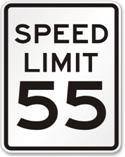
c. Using this new system of measurement, the Department of
Transportation will need to replace its speed limit signs. What would the following speed limit sign
look like if miles per hour were converted to kilometers per chron?
- The answers to the past homework assignments are posted on our website. Read through them and read through the comments we wrote on your homework papers. If there is a problem that you still do not understand, write down the problem number, the homework number, and a statement describing which part you don’t understand. E-mail this information to us so that we can talk about some of these questions in class on Tuesday as we review for the exam.
- The
online grocery shopping site www.peapod.com
lists full prices and unit prices for the items it sells. (In
a) Compute the unit price (the price per ounce) for each of the three bottles to decide which is cheapest. Show your work. You may then check the web site to see that your answers are correct.
b) Before you finish shopping you realize that you have a coupon for $1.00 off any size bottle. Redo the unit price calculations to decide which size bottle you should buy. Did your answer surprise you?
- In
class we estimated that we could fit about 300,000 books (300 kilobooks, 0.3 megabooks) into a computer with 200
gigabytes of memory. Would that take care of all the books in the UMass
- How many 200 gigabyte memories would you need to store all the books in the Library of Congress? (Recall that we estimated in class that each book took up 750,000 bytes, or 750 kilobytes, or three quarters of a megabyte.)