super Functionisinstance FunctionAre there any questions before I begin?
I have posted a solution to homework 9 here.
Let's take a look.
After I finish talking I will pass out the papers for today's graded quiz.
Write your name clearly at the top.
When you finish the Quiz hand it to me.
Then you can work on the Class Exercise and today's ungraded quiz.
def __init__(self, collection_no, name, length, format):
    self._coll_no = collection_no
    self._name    = name
    self._length  = length
    self._format  = format
for loop using the string method
isalnum
MIN_NAME_LENGTH = 3

class Video:
...

    def _check_name(name):
        if type(name) is not str:
            raise TypeError("Video constructor expects a string argument for name")
        char_count = 0
        for char in name:
            if char.isalnum():
                char_count += 1
        if char_count < MIN_NAME_LENGTH:
            raise ValueError("Name must have at least " + str(MIN_NAME_LENGTH) + \
                " characters that are letters or digits")
MIN_LENGTH      = 15
MAX_LENGTH      = 1000

class Video:
...
    def _check_length(length):
        if type(length) is not int:
            raise TypeError("Video constructor expects a integer argument for length")
        if length < MIN_NAME_LENGTH or length > MAX_LENGTH:
            raise ValueError("Length must be at least " + str(MIN_LENGTH) +
                " and no more than " + str(MAX_LENGTH))
FORMATS         = ("DVD", "Blue Ray")

class Video:
...
    def _check_format(format):
        if type(format) is not str:
            raise TypeError("Video constructor expects a string argument for format")
        if format not in FORMATS:
            raise ValueError("Format must be one of " + str(FORMATS))
# reads the last collection number used from a file,
# increments that number and writes it back to the file
# and returns the incremented number
def _next_coll_no():
    try:
        file = open(FILENAME, 'r')
        collection_no = int(file.readline())
    except FileNotFoundError:
        collection_no = 1
    else:
    	collection_no += 1
    finally:
        file = open(FILENAME, 'w')
        file.write(str(collection_no))
        return collection_no
def __init__(self, name, length, format):
    self._check_name(name)
    self._check_length(length)
    self._check_format(format)
    self._coll_no = self._next_coll_no()
    self._name   = name
    self._length = length
    self._format = format
def get_collection_no(self):
    return self._coll_no

def get_name(self):
    return self._name

def get_length(self):
    return self._length

def get_format(self):
    return self._format
def __str__(self):
    return str(self._coll_no) + ": " + self._name + ", " + \
        str(self._length) + " minutes, " + self._format
from video import Video
class SUBCLASS_NAME(SUPERCLASS_NAME):
class Movie(Video):
Video.__init__(...)
def __init__(self, name, length, format, director, studio):
    Video.__init__(self, name, length, format)
    self._director = director
    self._studio   = studio
    self._actors   = set()
>>> from movie import Movie
>>> m1 = Movie("Forbidden Planet", 98, "DVD", "Fred McLeod Wilcox", "MGM")
>>> str(m1)
'1: Forbidden Planet, 98 minutes, DVD'
>>> m1.get_collection_no()
1
>>> m1.get_name()
'Forbidden Planet'
>>> m1.get_length()
98
>>> m1.get_format()
'DVD'
def get_director(self):
    return self._director

def get_studio(self):
    return self._studio

def get_actors(self):
    return self._actors
>>> m1.get_director()
'Fred McLeod Wilcox'
>>> m1.get_studio()
'MGM'
>>> m1.get_actors()
[]
def add_actor(self, name):
        self._actors.add(name)
>>> m1.add_actor("Walter Pidgeon")
>>> m1.add_actor("Anne Francis")
>>> m1.add_actor("Leslie Nielson")
>>> m1.add_actor("Warren Stevens")
>>> m1.get_actors()
['Walter Pidgeon', 'Anne Francis', 'Leslie Nielson', 'Warren Stevens']
def __str__(self):
    return str(self._coll_no) + ": " + self._name + ", " + \
        str(self._length) + " minutes, " + self._format + \
        " Directed by " + self._director + ", " + self._studio
>>> str(m1)
Traceback (most recent call last):
  File "<stdin>", line 1, in <module>
  File "/Users/glenn/workspace-mars/it117/resources_it117/code_it117/example_code_it117/11_chapter_example_code/movie.py", line 26, in __str__
    ' Directed by ' + self._director + ', ' + self._studio
AttributeError: 'Movie' object has no attribute '_Movie_coll_no'
super Functionsuper
super returns something like a variable ...
def __str__(self):
    return super().__str__() + " Directed by " + self._director + ", " + self._studio
>>> str(m1)
'9: Forbidden Planet, 98 minutes, DVD Directed by Fred McLeod Wilcox, MGM'
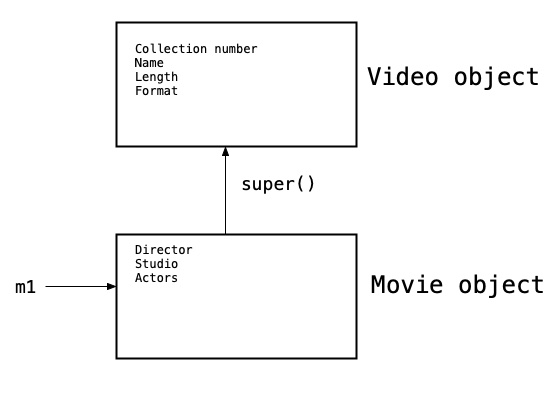
super connects to the base class object
def __init__(self, course_name, company, disc_number, instructor, length, format):
    Video.__init__(self, "XXX", length, format)
    self._course_name = course_name
    self._company     = company
    self._disc_number = disc_number
    self._instructor  = instructor
    self._lectures = []
COURSE_NAME: Disc DISC_NO
def get_name(self):
    return self._course_name + ': Disc ' + str(self._disc_number)
>>> i1.get_name()
'Understanding the Universe: Disc 1'
super().__str__()as we did in Movie
COLLECTION_NO: COURSE_NAME: Disc DISC_NO, INSTRUCTOR
def __str__(self):
    return str(super().get_collection_no()) + ': ' + self.get_name() + ', ' + self._instructor
>>> from instructional import Instructional
>>> i1 = Instructional("Understanding the Universe", "Great Courses", 1, "Alex Filippenko", 180, "DVD")
>>> str(i1)
'1: Understanding the Universe: Disc 1, Alex Filippenko'
def add_lecture(self, lecture):
    self._lectures.append(lecture)
def get_name(self):
    return str(super().get_collection_no()) + ": " + self._course_name + ": Disc " + \
        str(self._disc_number)

def get_course_name(self):
    return self._course_name

def get_company(self):
    return self._company

def get_disc_number(self):
    return self._disc_number

def get_instructor(self):
    return self._instructor

def get_lectures(self):
    return self._lectures
>>> i1.add_lecture("A Grand Tour of the Cosmos")
>>> i1.add_lecture("The Rainbow Connection")
>>> i1.add_lecture("Sunrise, Sunset")
>>> i1.add_lecture("Bright Objects in the Night Sky")
>>> i1.add_lecture("Fainter Phenomena in the Night Sky")
>>> i1.add_lecture("Our Sky Through Binoculars and Telescopes")
>>> i1.get_course_name()
'Understanding the Universe'
>>> i1.get_company()
'Great Courses'
>>> i1.get_disc_number()
1
>>> i1.get_instructor()
'Alex Filippenko'
>>> i1.get_lectures()
['A Grand Tour of the Cosmos', 'The Rainbow Connection', 'Sunrise, Sunset', 'Bright Objects in the Night Sky', 'Fainter Phenomena in the Night Sky', 'Our Sky Through Binoculars and Telescopes'
isinstance Functionisinstance built-in function
isinstance(OBJECT_VARIABLE, CLASS_NAME)
isinstance is a boolean function that returns True or False
>>> isinstance(i1, Movie)
False
>>> isinstance(i1, Instructional)
True
isinstance will also return True ...>>> isinstance(i1, Video) True
>>> from movie import Movie
>>> m1 = Movie("Forbidden Planet", 98, "DVD", "Fred McLeod Wilcox", "MGM")
>>> from instructional import Instructional
>>> i1 = Instructional("Understanding the Universe", "Great Courses", 1, "Alex Filippenko", 180, "DVD")
>>> videos = []
>>> videos.append(m1)
>>> videos.append(i1)
>>> for video in videos:
...     print(video)
...     print(video.get_name())
...
2: Forbidden Planet, 98 minutes, DVD Directed by Fred McLeod Wilcox, MGM
Forbidden Planet
1: Understanding the Universe: Disc 1, Instructor Alex Filippenko
Understanding the Universe: Disc 1
import random

# # Set up the colors
RED = (255, 0, 0)
GREEN = (0, 255, 0)
BLUE = (0, 0, 255)

class Shape:
    def __init__(self, window, max_width, max_height):
        self.window = window
        self.color  = random.choice((RED, GREEN, BLUE))
        self.x      = random.randrange(1, max_width - 100)
        self.y      = random.randrange(25, max_height - 100)

    def draw(self):
        pass
draw method uses Pygame code to render the shape
class Circle(Shape):
    def __init__(self, window, max_width, max_height):
        super().__init__(window, max_width, max_height)
        self.radius = random.randrange(10, 50)
        self.x_center= self.x + self.radius
        self.y_center = self.y + self.radius
        self.rect = pygame.Rect(self.x, self.y, self.radius * 2, self.radius * 2)

    def draw(self):
        pygame.draw.circle(self.window, self.color, (self.x_center, self.y_center),
                           self.radius, 0)
class Square(Shape):
    def __init__(self, window, max_width, max_height):
        super().__init__(window, max_width, max_height)
        self.width_height = random.randrange(10, 100)
        self.rect = pygame.Rect(self.x, self.y,
                                self.width_height, self.width_height)

    def draw(self):
        pygame.draw.rect(self.window, self.color,
                         (self.x, self.y, self.width_height, self.width_height))
class Triangle(Shape):
    def __init__(self, window, max_width, max_height):
        super().__init__(window, max_width, max_height)
        self.width = random.randrange(10, 100)
        self.height = random.randrange(10, 100)
        self.rect = pygame.Rect(self.x, self.y, self.width, self.height)


    def draw(self):
        pygame.draw.polygon(self.window, self.color,
                            ((self.x, self.y + self.height),
                             (self.x, self.y),
                             (self.x + self.width, self.y)))
shapes_list   = []
shape_classes = (Square, Circle, Triangle)
for i in range(0, NUM_SHAPES):
    random_class = random.choice(shape_classes)
    shape = random_class(window, WINDOW_WIDTH, WINDOW_HEIGHT)
    shapes_list.append(shape)
draw method of each Shape object
for shape in shapes_list:
    shape.draw()
